Re: Slow standby snapshot
| От | Michail Nikolaev |
|---|---|
| Тема | Re: Slow standby snapshot |
| Дата | |
| Msg-id | CANtu0ogpTvOtQgpQbKmHYjst6XBHowyHRhBHkN-54uoPOD4drw@mail.gmail.com обсуждение исходный текст |
| Ответ на | Re: Slow standby snapshot (Simon Riggs <simon.riggs@enterprisedb.com>) |
| Ответы |
Re: Slow standby snapshot
Re: Slow standby snapshot |
| Список | pgsql-hackers |
Hello, everyone.

I have tried to put it all together.

> In the absence of that approach, falling back to a counter that
> compresses every N xids would be best, in addition to the two new
> forced compression events.

Done.

> Also, if we add more forced compressions, it seems like we should have
> a short-circuit for a forced compression where there's nothing to do.

Done.

> I'm also wondering why there's not an
>
>     Assert(compress_index == pArray->numKnownAssignedXids);
>
> after the loop, to make sure our numKnownAssignedXids tracking
> is sane.

Done.

> * when idle - since we have time to do it when that happens, which
> happens often since most workloads are bursty

I have added getting of ProcArrayLock for this case.
Also, I have added maximum frequency as 1 per second to avoid
contention with heavy read load in case of small,
episodic but regular WAL traffic (WakeupRecovery() for each 100ms for
example). Or it is useless?

> It'd be more reliable
> to use a static counter to skip all but every N'th compress attempt
> (something we could do inside KnownAssignedXidsCompress itself, instead
> of adding warts at the call sites).

Done. I have added “reason” enum for calling KnownAssignedXidsCompress
to keep it as much clean as possible.
But not sure that I was successful here.

Also, I think while we still in the context, it is good to add:
* Simon's optimization (1) for KnownAssignedXidsRemoveTree (it is
simple and effective for some situations without any seen drawbacks)
* Maybe my patch (2) for replacing known_assigned_xids_lck with memory barrier?

New version in attach. Running benchmarks now.
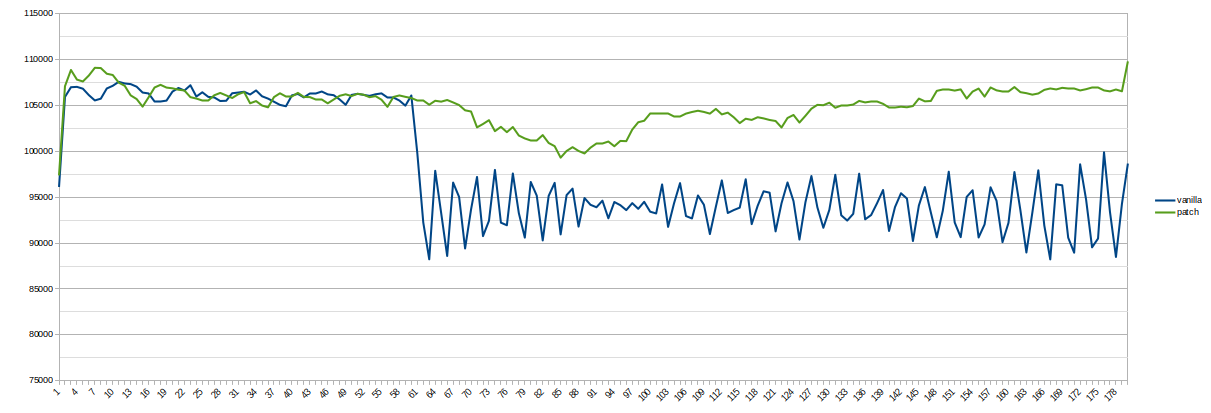
Preliminary result in attachments (16CPU, 5000 max_connections, now 64
active connections instead of 16).
Also, interesting moment - with 64 connections, vanilla version is
unable to recover its performance after 30-sec transaction on primary.

[1]:
https://www.postgresql.org/message-id/flat/CANbhV-Ey8HRYPvnvQnsZAteCfzN3VHVhZVKfWMYcnjMnSzs4dQ%40mail.gmail.com#05993cf2bc87e35e0dff38fec26b9805
[2]:
https://www.postgresql.org/message-id/flat/CANtu0oiPoSdQsjRd6Red5WMHi1E83d2%2B-bM9J6dtWR3c5Tap9g%40mail.gmail.com#cc4827dee902978f93278732435e8521

--
Michail Nikolaev
Вложения
В списке pgsql-hackers по дате отправления: